Doug Chapin for Congress
June 25, 2026 · Newsletter
Who Does Congress Actually Work For?

Imagine you and I are standing in a town hall with 1,000 of our neighbors.
Each of us gets one minute to speak.
One minute to talk about rising health care costs. One minute to talk about housing prices. One minute to talk about childcare, student loans, wages, retirement, public safety, or the challenges facing our communities.
Then a billionaire walks in. He buys every billboard in town. He buys every television commercial. Every radio ad. Every social media advertisement. Every piece of political mail sent to voters.
Technically, we still have free speech. We are still allowed to talk. But who is actually being heard?
That question has been rattling around a lot lately. Not because of one politician or one political party, but because of a growing feeling that seems to cut across ideology, geography, and party lines.
Nobody listens anymore.
The people in Washington do not understand us.
Congress works for somebody else.
For years, it was easy to dismiss that kind of frustration as cynicism. Democracy has always been messy. People have always been disappointed by politicians. Campaigns have always been loud, expensive, and frustrating.
But the more we look at how our political system is financed, the harder it becomes to ignore one simple question:
Who does Congress actually work for?
Over the last year, Doug and this campaign have spent time talking with voters across Minnesota’s Sixth Congressional District.
At doors, in coffee shops, at town halls, and at community events, we hear people express frustration about a lot of different issues.
Health care. Housing. Taxes. Immigration. Public safety. Wages. Schools. Retirement.
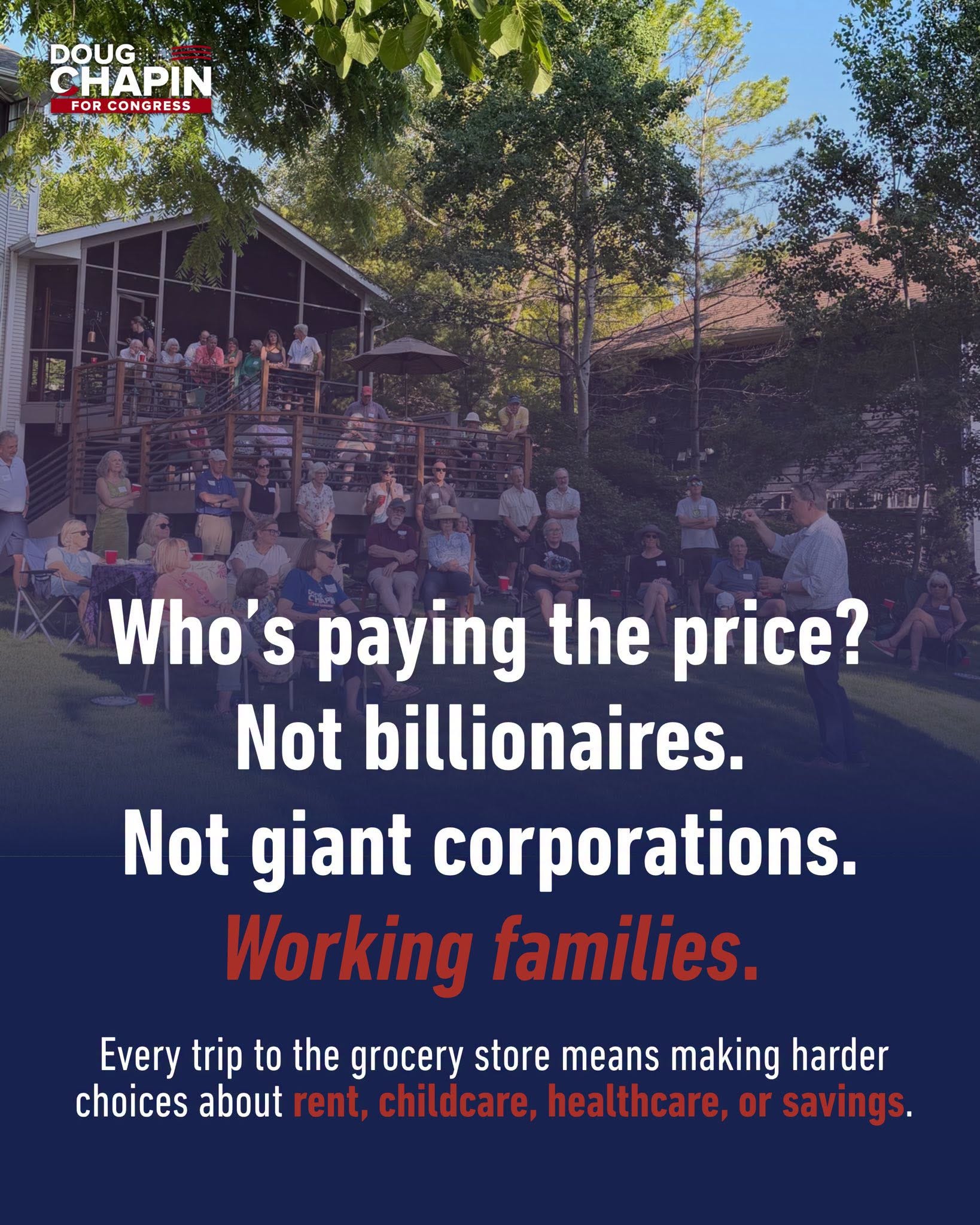
The concerns may change from one conversation to the next, but underneath many of them is the same deeper worry.
People do not trust the system anymore.
Not necessarily because they disagree with the outcome of one election or one policy debate.
Because they do not believe ordinary people are the ones driving the conversation.
We have heard voters say, “You can’t trust anything you hear anymore.” And frankly, a lot of Americans feel that way.
We have heard others say, “The billionaires control everything anyway.” That may sound harsh. It may sound cynical. But it is getting harder and harder to tell people they are wrong to be concerned.
Some blame Democrats. Some blame Republicans. A lot of people blame both.
What is striking is not the partisanship.
It is the feeling.
It is the feeling that your role in democracy ends after you cast a ballot, and that the people with real influence are the people with the deepest pockets.
Whether that feeling is always fully fair or not, it deserves to be taken seriously.
Because democracy cannot survive on ballots alone.
Democracy also depends on trust.
The Bet
In 2010, the Supreme Court issued one of the most consequential political decisions in modern American history: Citizens United v. Federal Election Commission.
The case was not really about billionaires. It was not even primarily about the kind of campaigns we see today.
It was about speech.
The five-justice majority argued that the government could not restrict independent political spending by corporations, unions, and other organizations because political spending was a form of protected speech.
Supporters of the decision viewed it as a victory for the First Amendment.
Their argument was straightforward: the government should not get to decide who is allowed to participate in political debate.
More speech, they argued, would strengthen democracy. Less censorship would strengthen democracy.
The Court also concluded that independent expenditures — money spent separately from a candidate’s campaign — did not present the same corruption concerns as direct contributions to candidates.
That was the bet. More political spending, more political speech, more democracy.
Sixteen years later, we have enough evidence to ask whether that bet paid off.
What Actually Happened
The results have been staggering.
Citizens United alone did not create the campaign finance system we have today. Other court decisions, especially SpeechNow.org v. FEC, helped build the legal framework that made modern super PACs possible.
Political consultants adapted, campaigns adapted, donors adapted.
And the money poured in.
In the years after Citizens United, outside spending began to grow dramatically. By 2024, outside political spending reached levels that would have been almost unimaginable a generation ago. Dark money, political spending where the true source of funding is often hidden from voters, hit record levels as well.
That matters. Because political spending did not just increase.
It became a central feature of modern American politics.
And increasingly, that spending is concentrated among a relatively small number of extraordinarily wealthy individuals, corporations, and interest groups.
The problem is not that people participate in politics. The problem is that the scale of participation is wildly unequal. Most Americans get one vote. A billionaire gets one vote too.
But a billionaire may also get a super PAC, a lobbying operation, a media strategy, a network of advocacy groups, and enough resources to shape what millions of voters see, hear, and read.
That does not mean billionaires control every election.
It does not mean voters are powerless.
But it does mean the wealthiest voices in America occupy a completely different universe of political influence than the average citizen.
The Billionaire Era
The most revealing thing about the post-Citizens United era is not simply that more money entered politics.
It is who can now deploy it.
In recent election cycles, Americans have watched individual billionaires spend sums that would have been almost unthinkable in earlier eras.
Elon Musk reportedly spent hundreds of millions of dollars through political organizations supporting candidates and causes he favored.
Crypto-industry super PACs poured more than $100 million into congressional races, helping shape debates over digital asset regulation. House Majority Whip Tom Emmer being a central figure.
Major donors on both the left and the right have increasingly become political institutions unto themselves, capable of funding advertising campaigns, voter outreach operations, issue advocacy groups, and candidate-support networks that rival traditional party organizations.
To be clear, this is not only a Republican problem. And it is not only a Democratic problem.
It is a system problem.
The concern is not that wealthy Americans have political opinions. They do, and they have every right to express them.
The concern is that a tiny number of people now possess the financial ability to amplify those opinions at a scale unavailable to virtually everyone else.
That is not a healthy marketplace of ideas.
That is a political system where some people get a microphone, and others get a stadium sound system.
The View From Main Street
Here in Minnesota’s Sixth District, most people are not spending their evenings reading Supreme Court opinions or campaign finance reports.
Most people could not define every type of political committee.
Most people do not know the legal distinction between direct contributions, independent expenditures, dark money nonprofits, and super PACs.
But they know how the system feels. They see prescription drug prices climbing. They see housing becoming harder to afford. They see grocery bills that still feel too high. They see student debt burdens. They see large corporations receiving favorable treatment while small businesses struggle. They see lobbyists swarming Capitol Hill. They see billionaires funding political campaigns.
And they wonder whether their concerns carry the same weight as someone capable of writing an eight-figure check.
That perception matters.
Because if enough people begin to believe that elected officials are more responsive to donors than voters, the legitimacy of the entire system begins to erode.
And once trust is gone, it is incredibly difficult to get back.
The Question Nobody Wants to Answer
Defenders of the current system often argue that money does not buy votes.
And they are right.
A billionaire cannot legally purchase a vote in Congress. A corporation cannot legally order a member of Congress to vote a certain way. American politics is more complicated than that. But there is a different question that rarely gets asked.
If money does not buy influence, why do wealthy individuals and special interests spend so much of it trying?
Why do industries spend hundreds of millions of dollars lobbying Congress? Why do corporations maintain armies of lobbyists? Why do donors contribute enormous sums to super PACs? Why does political spending continue to rise election after election?
No serious investor pours money into something year after year expecting no return.
The people funding our political system clearly believe access matters. They clearly believe influence matters. They clearly believe their investment matters. The rest of us are left to decide whether they are wrong.
Why This Matters in the Sixth District
This is where the national conversation becomes local.
Tom Emmer is not a bystander in Washington. He is not some powerless observer watching this system from the outside.
He is the House Majority Whip, one of the highest-ranking members of House Republican leadership. He knows how Washington works. He knows how power moves. He knows who gets access, who gets meetings, who gets listened to, and who gets told to wait. So the question for Minnesota’s Sixth District is simple:
Is our representative using that power to make Congress work better for ordinary people? Or is he helping preserve a system where working families are expected to be patient while the wealthy and well-connected move to the front of the line?
Because across this district, people are not asking for special treatment. They are asking for a government that hears them.
They are asking for health care that does not bankrupt them. They are asking for housing they can comfortably afford. They are asking for wages that do more than just “keep up” with the cost of living.
They are asking for safe communities, strong schools, and a future their kids can believe in.
They are asking for Congress to remember who it works for.
That should not be too much to ask.
Do you know someone who should be readying this newsletter? Share with them and help spread the word about Doug’s campaign!
The Test of a Democracy
Maybe the defenders of Citizens United are right. Maybe more money in politics simply means more speech.
Maybe billionaires, corporations, unions, advocacy groups, and ordinary citizens are all just participating in the marketplace of ideas.
But if that is true, why do so many Americans feel ignored?
Why does Congress seem capable of moving with breathtaking speed when powerful interests demand action, while problems affecting millions of ordinary families linger for years or decades?
Why has trust in our institutions continued to erode?
These are not partisan questions. They are democratic questions.
Because the health of a democracy is not measured only by whether people are allowed to vote.
It is measured by whether people believe their voices matter after the election is over.
Sixteen years ago, the Supreme Court made a bet. It bet that unlimited independent spending would not corrupt our politics. It bet that transparency would provide sufficient safeguards. It bet that more political spending would ultimately strengthen public debate.
Today, Americans are still living with the consequences of that bet. The question is whether it worked.
And whether Congress still works for the people it was created to represent.
Doug Is Running to Change Who Gets Heard
Doug Chapin is running for Congress because Minnesota’s Sixth District deserves a representative who remembers that public service means serving the public.
Not donors.
Not lobbyists.
Not party leadership.
Not billionaires.
The public.
Doug has spent his career working on democracy, elections, and public service. He understands that trust is not restored by slogans or press releases. It is restored by showing up, listening, doing the work, and building a government that people can believe in again.
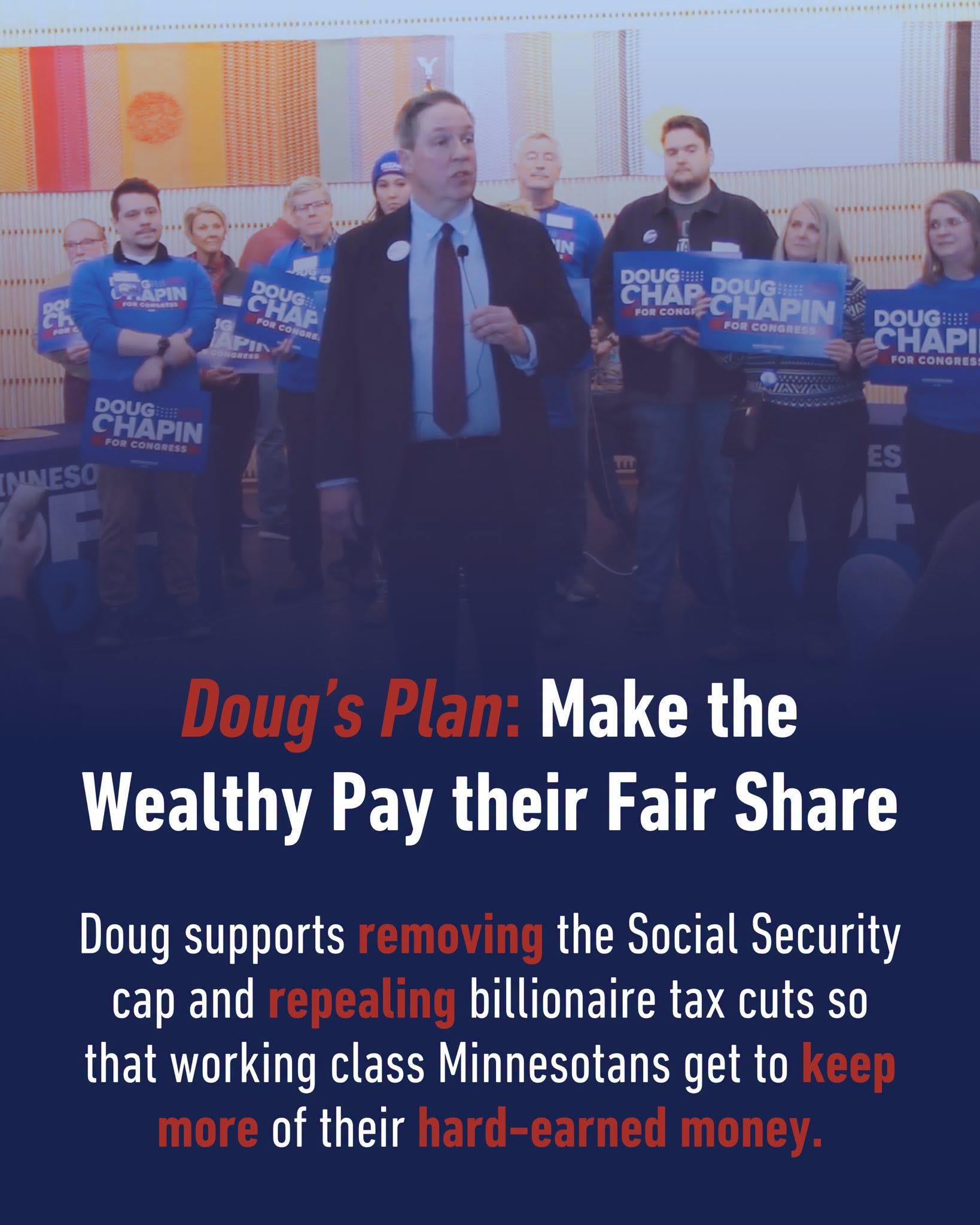
That is what this campaign is about. It is about proving that ordinary people still matter. It is about building a campaign powered by neighbors, volunteers, conversations, door knocks, small donations, and community. It is about reminding Washington that Minnesota’s Sixth District is not for sale.
And it is about sending someone to Congress who knows exactly who he works for.
Show Up With Us Around the District
From parades and Pride to door knocks across the Sixth District, there are plenty of ways to get involved with Team Chapin this week.
We’ve made the week’s schedule easy to scan below. Whether you want to walk with the Democracy Rescue Rig, celebrate with Doug at a community event, or help talk with voters in neighborhoods across the district, we’d love to have you with us.
See full event details and sign up here:
https://www.mobilize.us/chapinforcongress/

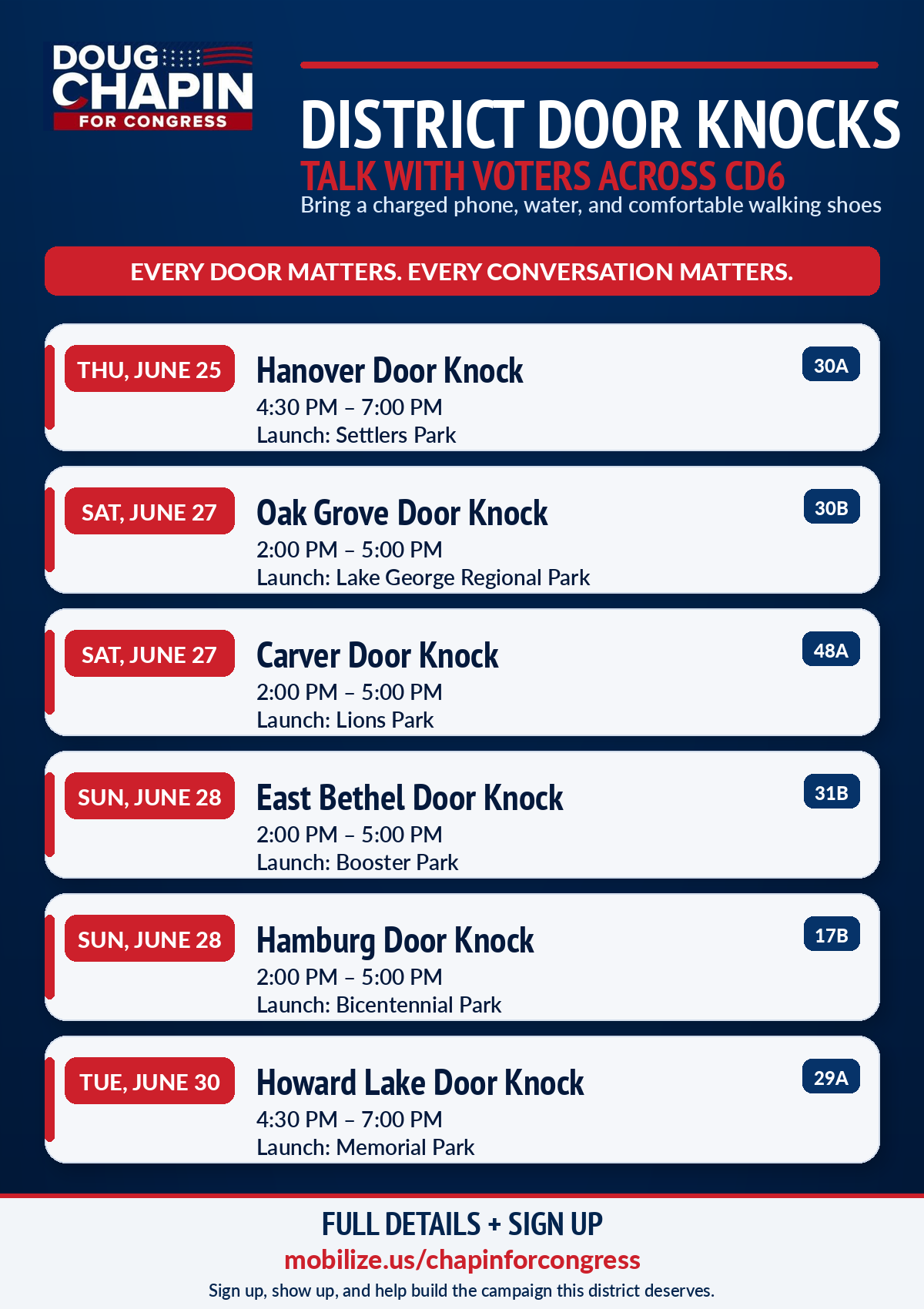
Every conversation matters. Every event matters. Every volunteer helps us build the campaign this district deserves.
Let’s keep showing up!
Ready for Better
The Sixth District deserves better than a Congress that listens most closely to whoever can spend the most money.
We deserve better than a politics that leaves people feeling ignored, exhausted, and powerless.
We deserve better than a system where working families are asked to wait while lobbyists and billionaires get the first call back.
Doug Chapin is running because government should work for all of us.
And this campaign is growing because people across the Sixth District are ready to be heard again.
So let’s keep showing up.
Let’s keep knocking doors.
Let’s keep bringing the Democracy Rescue Rig into communities across the district.
Let’s keep building a campaign that proves ordinary people still have power when we stand together.
Because Congress should work for us.
All of us.
And the Sixth District is ready for better.
131 days until Election Day. Let’s make every one count!
#Flipthe6th #LFG #ReadyforBetter
Thanks for reading! Be sure to subscribe to keep up to date on the great things Doug Chapin for Congress has going on around the Sixth District!