Doug Chapin for Congress
July 30, 2026 · Newsletter
America's Unpaid Invoices

It usually starts with a list.
Pencils. Notebooks. Glue sticks. A couple boxes of tissues. Markers. Folders.
Then you add the bigger stuff, a backpack because last year’s is hanging on by a thread, shoes because somehow the ones that fit in June are suddenly too tight in August.
None of it feels outrageous on its own.
And then you’re standing at the register, watching the total climb, and you realize how fast “reasonable” turns into “how are we supposed to do this?”
For families already juggling groceries, childcare, car trouble, rent, and the long list of everyday things that keep getting pricier, back-to-school shopping isn’t a small errand. It’s another bill landing right when there’s the least space for one.
Parents cover it because their kids need what’s on that list.
And when they can’t, teachers often do.
As August approaches, educators across the country are preparing to spend hundreds of dollars from their own paychecks on classrooms filled with students they may not have even met yet.
They buy extra pencils because pencils have a way of growing legs and walking away.
They buy notebooks because someone will arrive without one.
They buy snacks because hungry kids have a hard time concentrating.
They pick up tissues, cleaning supplies, books, decorations, and whatever else might make the classroom feel welcoming on the first day.
They do it because they care about their students.
They also do it because, if they do not, there is a good chance nobody else will.
That receipt is not just a receipt.
It is an unpaid invoice.
And every year, ordinary people pick up millions of them.
The Price of Growing Up
We like to talk about education as if it starts the first day a kid sits at a desk.
Parents know better.
It begins with childcare, often years before kindergarten. Then come clothes, shoes, school supplies, lunch accounts, activity fees, sports equipment, field trips, instrument rentals, technology, and transportation.
Children have always needed things. That part is not new.
What has changed is how much harder it has become for many families to cover those costs while keeping up with everything else.
So parents adjust.
They watch for sales. They reuse what they can. They pass clothes between siblings. They put off buying something for themselves. Sometimes they put the whole purchase on a credit card and hope next month leaves a little more breathing room.
When a family cannot cover everything, the need does not disappear.
It moves down the line.
A teacher buys the extra notebook.
Another parent picks up a second backpack.
A church collects supplies.
A neighbor helps with new shoes.
And more often than not, the help comes from someone who understands exactly what it feels like to need it.
The People Who Know the Cost
Generosity does not always come from abundance.
Often, it comes from memory.
The parent who once needed help buys an extra set of supplies.
The retired couple living on a fixed income still gives to the local food shelf.
The teacher watching every dollar in her own grocery budget makes sure a student has something to eat.
People recognize that look on someone else’s face because they have worn it themselves.
They remember standing at a register hoping the card would go through.
They remember being the only kid without the right supplies.
They remember how much it meant when someone helped without drawing attention to it or making them feel ashamed.
That generosity is one of the best things about our communities.
It should also make us uncomfortable.
The people with the least flexibility in their own budgets are often the first to find room for someone else.
Meanwhile, many of the people with the power to change these conditions are still debating whether teachers deserve better pay, whether schools need more support, or whether families should simply learn to live with less.
They praise teachers for raising money for their classrooms, then resist paying them more.
They complain about long supply lists, then oppose the investments that could shorten them.
They celebrate parents who organize another fundraiser and point to that fundraiser as evidence that the system is working.
It is not working.
People are working around it.
The Quiet Economy
Every day there’s a whole economy propping up our lives that never shows up in a stock ticker.
It’s donated clothes and volunteer hours, meal trains after funerals, rides to appointments, grandparents watching grandkids so Mom and Dad can get to work.
No quarterly call reports the value of a volunteer firefighter pushing back from the dinner table to head into the night.
Still, this quiet economy is one of the strongest things holding our communities together.
It runs on time and money people don’t always have to spare.
It runs on that sense that we’re responsible for one another.
Minnesotans see it everywhere, in food shelves, youth sports, community festivals, church basements, veterans’ centers, local service clubs. You see it after a snowstorm too, somebody clearing their neighbor’s driveway before they finish their own.
Those acts deserve real appreciation. But appreciation can’t be where the conversation ends.
How many essential pieces of American life are running only because ordinary people keep absorbing costs that were never meant to be theirs?
When Sacrifice Becomes the Plan
Those unpaid invoices keep following us.
They show up when food shelves are serving families where one or both parents already work.
They show up when a nurse stays late because the next shift is short.
They show up when rural families drive hours for care because nearby services have been stripped away.
They show up when parents, teachers, social workers, first responders, caregivers, and public employees are expected to make up for every shortage with “grit” and “personal sacrifice.”
The pattern is familiar.
Something is needed. The system falls short. Someone nearby steps in.
We have become so used to it that we often stop asking questions.
Instead, we turn sacrifice into a job requirement.
We call teachers dedicated because they spend their own money.
We call grandparents selfless because they reorganize their lives to provide childcare.
We call volunteers heroes because they keep important services running.
They deserve that praise.
But sometimes calling someone a hero is easier than asking why heroism was necessary.
When a teacher spends hundreds of dollars preparing a classroom, the story is not only that the teacher is generous.
The story is also that the classroom was not properly supplied.
When volunteers raise money for playground equipment, the story is not only that the community came together.
The story is also that children needed something their community could not otherwise provide.
When a food shelf serves a record number of working families, we should absolutely recognize the volunteers.
We should also ask why full-time work no longer guarantees that a family can afford enough food.
Generosity can solve the immediate problem, it can’t be the permanent plan.
We Celebrate the Wrong Part of the Story
Americans love stories of people stepping up, and we should. Those stories remind us who we can be.
But it’s easy to get so focused on the person who saved the day that we forget to ask why the day needed saving.
When a teacher spends their own money getting a classroom ready, it isn’t only a story about generosity. It’s also a story about a classroom that wasn’t properly supplied.
When volunteers raise money for playground equipment, it isn’t only a story about community spirit. It’s also a story about kids needing something the system didn’t provide.
When a food shelf serves record numbers, it shouldn’t only be about the volunteers who responded. It should also force us to face the fact that full-time work no longer guarantees enough food.
Generosity can handle the emergency in front of you.
It can’t stand in for a system that functions.
A food drive can fill shelves for a month, it doesn’t answer why working families are hungry.
Personal sacrifice can’t be our permanent plan.
Generosity Should Be a Gift, Not a Requirement
Strong communities will always depend on people caring for one another. That shouldn’t change.
Government can’t replace a neighbor checking in after a storm.
It can’t manufacture the instinct of a teacher who notices a kid struggling.
It can’t recreate the bond between a volunteer coach and a young person who needs someone in their corner.
And it shouldn’t try.
But there’s a difference between a community made better by generosity and a community that only functions because generosity is assumed.
Giving is something people choose. Dependence is what happens when institutions start counting on that choice.
We should want teachers who bring compassion and creativity into the classroom, and we should not be requiring them to cover budgets with their own wallets.
We should value grandparents who want to be part of their kids’ and grandkids’ lives, and we shouldn’t be forcing families into unpaid childcare arrangements because there’s no affordable alternative.
A community’s generosity should be the extra care that makes it special.
It shouldn’t be the beams holding the whole structure up.
What Leadership is Supposed to Do
That’s where leadership comes in.
Leadership isn’t praising sacrifice while refusing to reduce the need for it.
It isn’t handing out kind words during Teacher Appreciation Week and then brushing off requests for better wages.
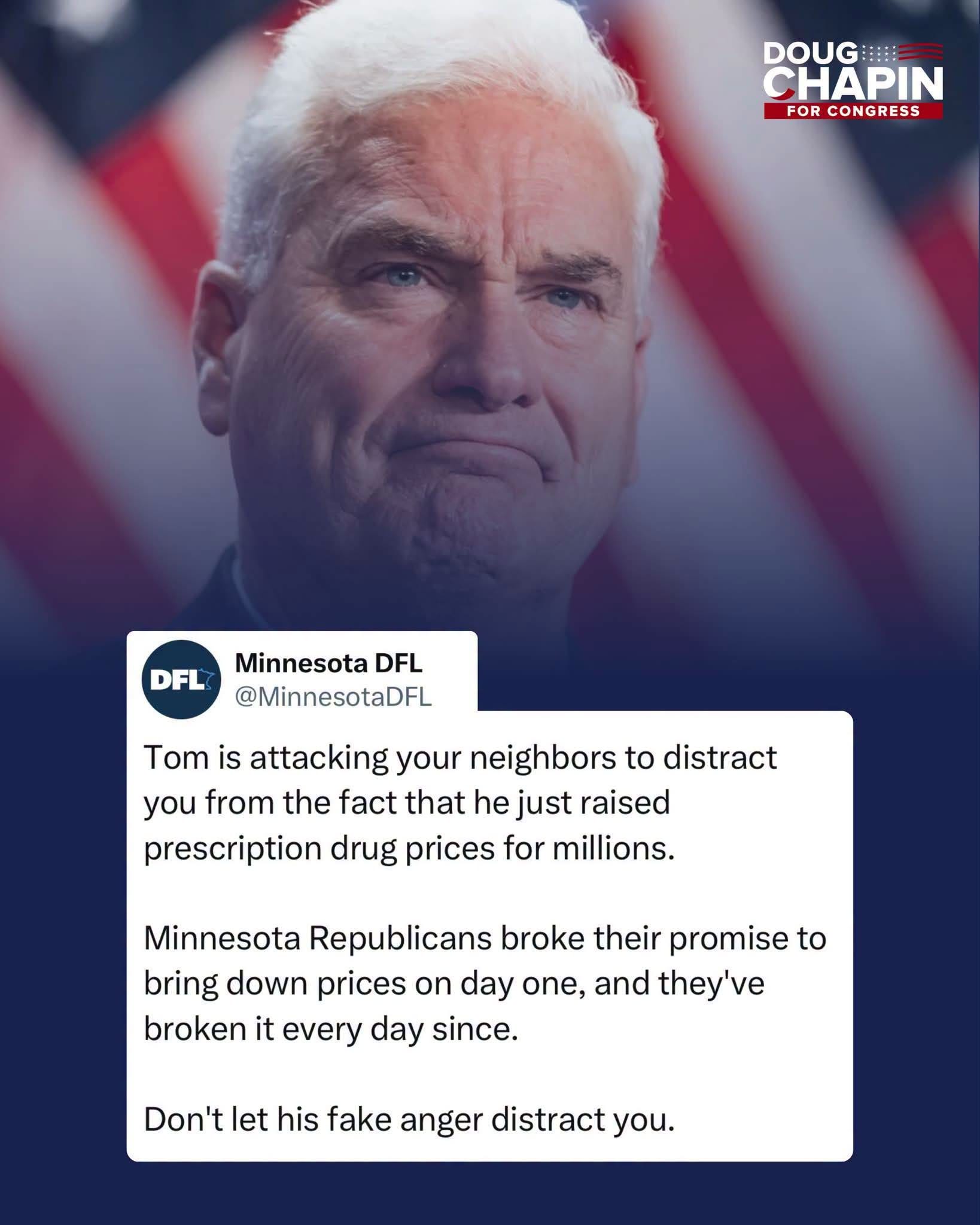
It isn’t telling families you hear them while spending day after day in Congress fighting for more billionaire tax breaks.
It isn’t claiming you care about health and safety while burning your time chasing culture-war camera moments.
Leadership starts with noticing who’s carrying the weight, then asking whether it makes sense that they’re carrying so much of it alone.
That means investing in public schools and treating educators like the professionals they are.
It means making childcare and healthcare accessible.
It means backing rural hospitals, first responders, food assistance, veterans’ services, and the local institutions that keep communities steady.
It means building an economy where work brings enough stability that families can help their neighbors without risking their own footing.
And it means listening to the people actually doing the work.
Not lobbyists. Not the loudest accounts online.
The teacher buying supplies, the parent stretching a paycheck, the volunteer filling a gap.
The people paying America’s unpaid invoices.
Water Tower Wednesday: Chaska

One of Doug’s favorite parts of traveling across Minnesota’s 6th is getting time in the communities that make it such a meaningful place to call home.
This week’s Water Tower Wednesday brings us to Chaska.
Along the Minnesota River, Chaska blends natural beauty with local history and plenty to do if you’ve got an afternoon to wander. The historic downtown has a lot of local restaurants and businesses, and Firemen’s Park gives the city a gathering spot right in the center of town.
Miles of trails connect the area, and you’re a short drive from the Minnesota Landscape Arboretum.
Chaska has also built a national name in curling. The Chaska Curling Center is one of the top facilities in the country and has introduced thousands of people to a sport with deep roots here in Minnesota.
As always, the best part of any stop in the Sixth is meeting the people who live there.
Have a favorite restaurant, coffee shop, park, or hidden gem in Chaska? Let us know what Doug should check out next time he’s in town.
Choose How You Make a Difference
Winning a district as large and varied as Minnesota’s Sixth takes more than one candidate driving from town to town. It takes a team of volunteers willing to help introduce Doug to voters, listen to what matters to them, and build the kind of personal connection that moves a campaign.
And not everybody has to volunteer the same way.
Some people like walking neighborhoods and talking face-to-face. Others would rather call from home. Some can give a full afternoon, others only a couple hours after work.
All of it counts, and Team Chapin has more options now for getting involved.
This week we’ll be knocking doors in Buffalo, Monticello, St. Cloud, Clearwater, and Rockford. If you’ve knocked hundreds of doors or you’ve never joined a campaign before, come out with us.
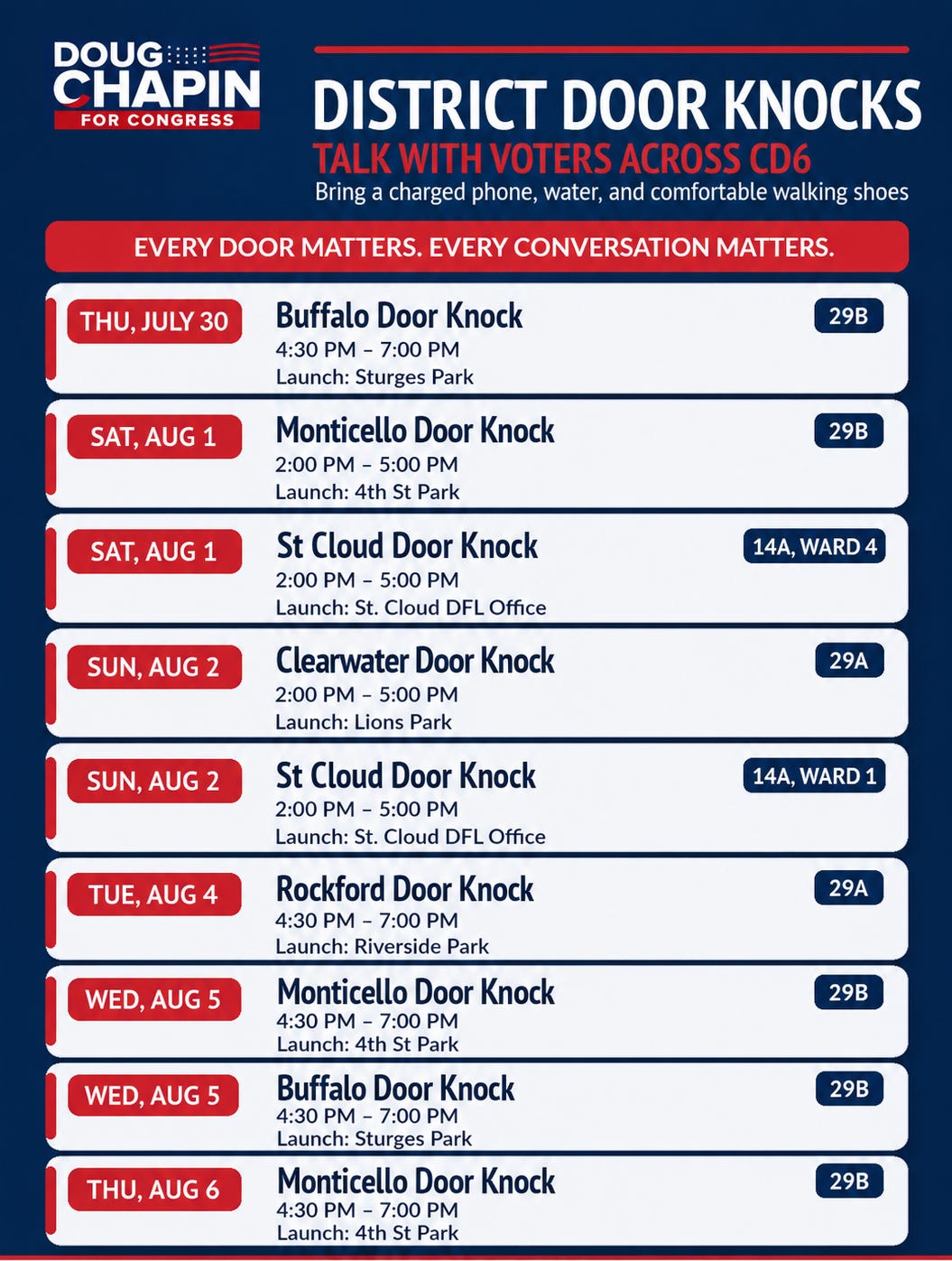
View more details and sign up at: mobilize.us/chapinforcongress
Volunteer From Home With Team Chapin
We also get that door knocking isn’t for everyone.
Phone banking lets volunteers talk with voters across the district without leaving home. You’ll just need a computer, a phone, and steady internet.
Each shift starts with quick technical help and a script run-through on Google Meet. Organizers will guide you, answer questions, and make sure you feel ready before the first call.
No campaign experience required.
Your job isn’t to have every answer or deliver a perfect speech. It’s to start a real conversation, hear what matters to someone, and help them understand the choice in the next election.
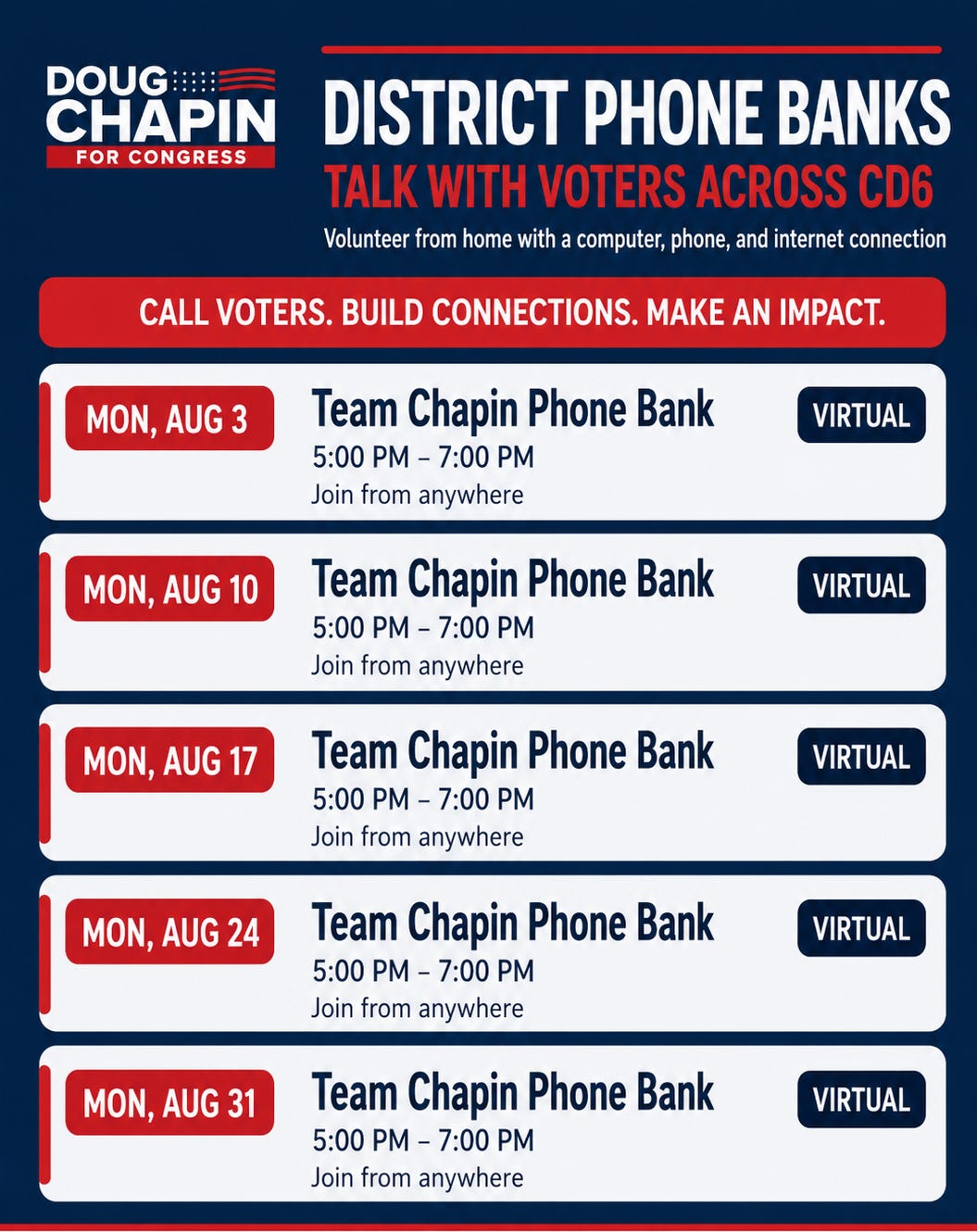
Sign up for a Team Chapin Monday phone bank - Dates open for September and October!
Help Us Fill the Streets in Hanover
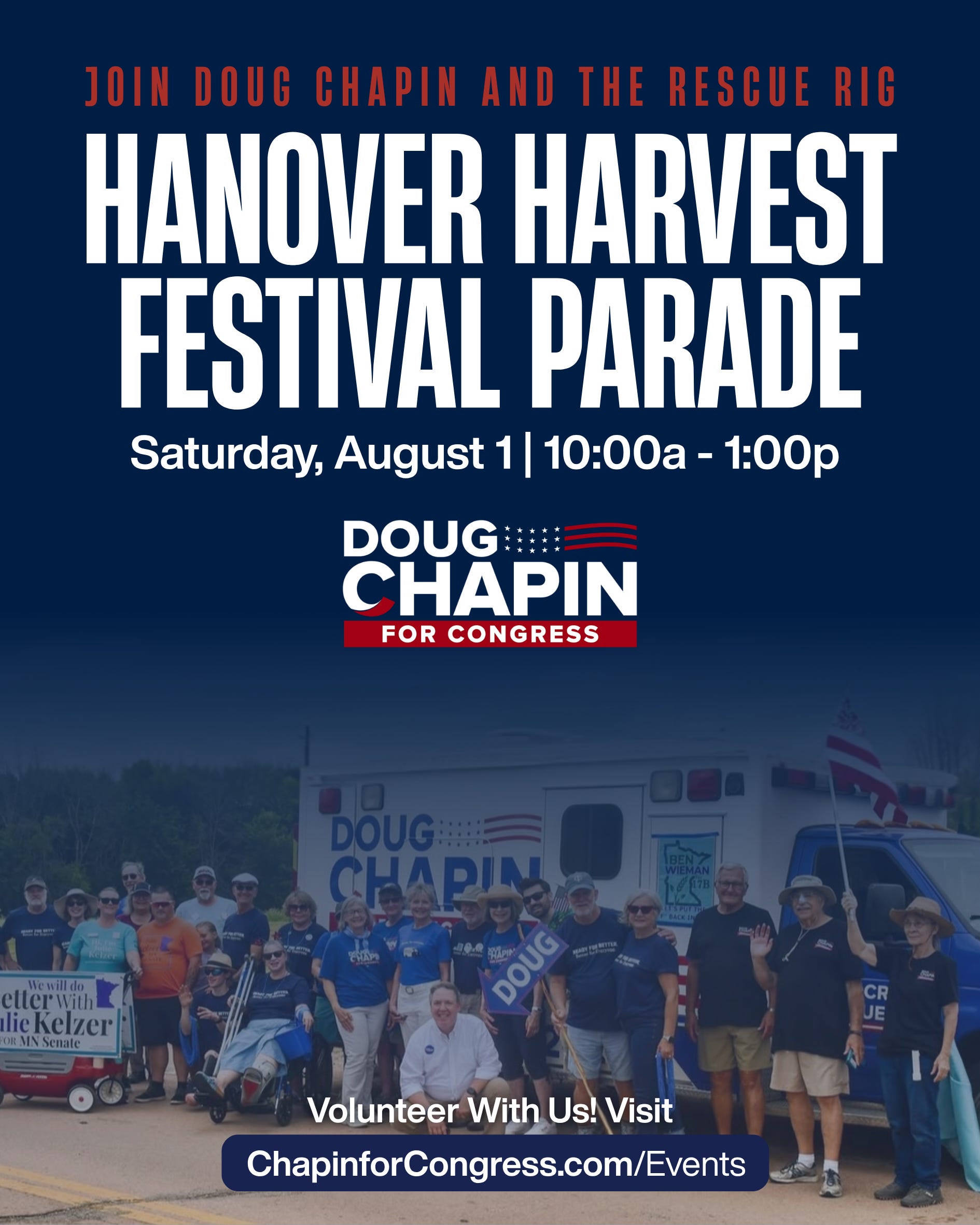
Team Chapin is hoping for a big turnout at the Hanover Harvest Festival Parade this Saturday.
Doug and the Democracy Rescue Rig will be joining the parade, and volunteers are needed to help us hand out candy and freezies, carry flags and signs, blow bubbles, dance along to the music, and keep the energy going throughout the route! We may also need a few people riding in the back of the rig to help restock treats.
As always, no parade experience required. Just bring comfortable shoes, dress for the weather, and come ready to have some fun!
If you are interested in driving the Democracy Rescue Rig, you can email our Volunteer Coordinator at [email protected].
Day-of details will be emailed to registered volunteers!
Ready for Better
Doug knows government can’t fix every problem.
But it also shouldn’t keep creating problems for the people already carrying the heaviest load.
Minnesota has never been short on generous people, that’s one of our strengths. Still, we can’t mistake ordinary people’s willingness to sacrifice for proof that everything is fine. A lot of the time it means the opposite.
The debt keeps getting passed down until it lands on a kitchen table, in front of someone who knows what happens if they don’t pay it.
So they pull out the wallet. They shift their schedule. They give up another evening.
They make it work.
They always do.
The people who keep showing up for their communities deserve leaders who finally show up for them.
That’s the kind of leader Doug is, and that’s the kind of congressman Doug intends to be.
As Doug recently said:
“It’s time to put affordability, opportunity and working families back at the center of the job. I’m the candidate Minnesotans can count on to do exactly that.”
We’re under 100 days now, 96 until Election Day. Get out there and make every day count. That’s what this campaign is doing.
#Flipthe6th #LFG #ReadyforBetter
Thanks for reading! Be sure to subscribe to stay connected and hear about the great things happening with our campaign!